1998 FIFA World Cup
And Their Children After ThemThe 1998 FIFA World Cup becomes more than a sequence of football matches in the novel: France’s run to the final supplies a national story that residents of Heillange can watch, repeat, and briefly inhabit together. Its most consequential scene is the semifinal against Croatia, where a dramatic comeback transforms a crowded bar and then the town into a celebration. For Anthony and Hacine, the shared spectacle creates a short-lived interval of amnesty between men whose relationship has long been marked by conflict.
The tournament enters everyday life
By the time France reaches the semifinals, the competition has saturated ordinary routines. At the expanded E.Leclerc store, Anthony shops among crowds and promotional displays while the country’s tricolor colors and the announcement that France has reached the semifinals recur across the media. His errands continue, but even a shopping trip becomes an occasion for encountering acquaintances and exchanging news. Football’s national importance is thus registered not only in stadiums and bars but in the small public rituals of everyday life.
Hacine follows the team’s progress with an intensity that contrasts with his troubled home life. After France advances through the first round, eliminates Paraguay, and defeats Italy in the quarterfinals, he watches matches, recaps, news reports, commentaries, and replays, and buys newspapers. The coverage is exciting, but it also gives him a way to turn away from the strain between himself and Coralie. She returns after a brief stay with her parents, and the couple barely speaks. While Hacine immerses himself in the tournament, he notices her disapproval in ordinary household gestures and recognizes that her sadness weighs on him. He keeps his distance, sleeps on the sofa, and does only a limited share of caring for their baby. The national drama offers temporary absorption, not a solution to the intimate crisis he is avoiding.
The semifinal against Croatia
On the day of the semifinal, Hacine’s workmates head to the large screen at Renardière stadium, but he declines to join them. He rides through town instead, passing packed bars before eventually arriving at L’Usine, a place he had not visited since an earlier incident. The match has already become a shared local occasion, yet Hacine enters it alone, moving through the town’s excitement before settling among the spectators.
Croatia takes the lead in the forty-sixth minute when Davor Šuker converts a long pass from Asanović. The goal leaves the watching crowd stunned. In the next minute, Lilian Thuram scores for France, and the bar erupts: people shout, embrace, and jump in place. Hacine raises his fists; Anthony, who has recognized him, shakes him in an ecstatic, almost childlike celebration. The reversal makes the two former antagonists participants in the same spontaneous response. For that moment, the match commands their attention more completely than their feud.
Thuram scores again in the seventieth minute. France’s lead changes the atmosphere from suspense to collective certainty: the people in the bar seem to merge into a single crowd, with the narration presenting their unity as an intense national fantasy in which old divisions and obligations appear momentarily erased. Anthony and Hacine drink amid the celebration, while Anthony’s cousin and Rudi join the revelry. The crowd’s solidarity is powerful precisely because it is temporary and imagined rather than the result of any lasting reconciliation.
Heillange celebrates France’s place in the final
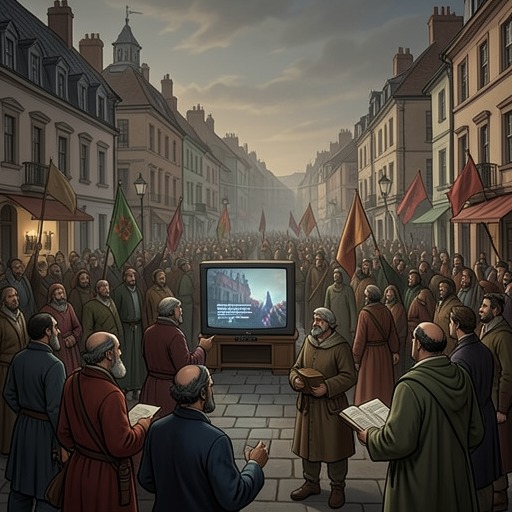
When the match ends, France has won the semifinal and reached the final. Heillange spills into the streets. Cars clog the roads and sound their horns; flags appear at windows and wave above the crowds; faces are painted in blue, white, and red. Young people set off firecrackers, pedestrians toast one another with cans of beer, and revelers climb across car hoods in the traffic. The police watch with indulgence as strangers stop to embrace and kiss them. At City Hall, champagne is brought out, while a local reporter collects residents’ first reactions for the next day’s newspaper.
The language of the celebration repeatedly makes victory collective: people speak as a shared we, claiming the win and the place in the final together. A few Algerian flags also appear in the streets, complicating any simple picture of a single, uniform national display. Meanwhile, the local National Front office has shut its metal shutter. The scene presents the celebration as a powerful public image of belonging, but it does not establish that the town’s underlying differences have disappeared. Its force lies in the brief sense that the whole community can occupy the same moment.
A truce without reconciliation
Later, around midnight or one in the morning, Anthony and Hacine are outside L’Usine. The streets have quieted to occasional explosions and car horns, and Anthony is so unsteady from drinking that he leans against a wall to light a cigarette. Through the evening, the two have largely avoided each other. Only the late hour, alcohol, France’s victory, and the surrounding mood of amnesty make an exchange possible. Hacine approaches and speaks first. The World Cup has brought them into the same celebration and loosened the silence between them, but this encounter marks a pause in their antagonism, not proof that its causes have been settled.